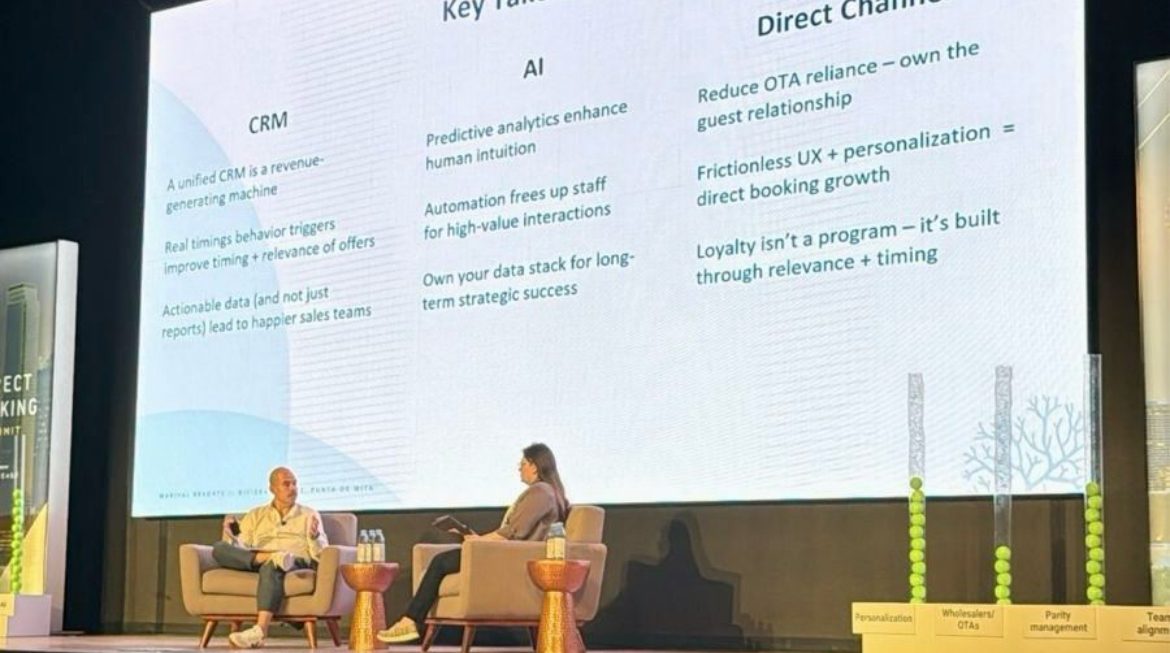
Hace exactamente un año subí a un escenario en Dallas frente a varios cientos de profesionales de hospitalidad para contar cómo llevamos un portafolio de resorts de $88M a $121M USD y el canal directo de 29% a 53% de market share usando AI en CRM. Tenía ansiedad, hablaba en mi segundo idioma, y la noche anterior no dormí. Eso ya lo conté en otro post.
Hoy quiero contar otra cosa. Qué pasó con esa estrategia 12 meses después. Qué se confirmó del summit. Qué se desinfló. Y por qué la edición de 2026 (que arranca la próxima semana en Mexico City) va a ser distinta a todo lo que hemos visto.
Lo que el DBS Dallas 2025 nos dijo, y nadie quería escuchar
El reporte oficial post-evento, basado en datos de 125 millones de reservas globales analizadas por SiteMinder, dejó tres números que se quedaron rondándome todo el año:
El primero: una reserva directa genera en promedio $519 USD vs $320 USD de una reserva por OTA. 60% más revenue por la misma habitación. Y aún así, las OTAs capturaron el 61% de las reservas en hoteles independientes en 2024 (vs 35% en cadenas). El gap entre lo que sabemos y lo que ejecutamos sigue abierto.
El segundo: Gartner proyectó que las marcas pueden perder hasta 50% de su tráfico directo por buscadores de IA para 2028. Hoy, 24% de los adultos jóvenes ya se quedan en el resumen de la IA sin clickear a tu sitio. Cuando lo escuché en mayo de 2025, sonaba a futuro. Hoy ya estoy auditando hoteles donde el tráfico orgánico bajó 15-20% en 12 meses.
El tercero, y el que más me interesa por nuestro contexto: 21% de los viajeros en México empiezan su búsqueda de hotel en redes sociales o foros, casi el doble del promedio global (11%). El mexicano busca distinto. Y eso cambia cómo deberíamos invertir aquí.
Lo que se confirmó
El canal directo ya no se discute. Hace un año todavía me tocaba explicar a directores generales por qué dejar de depender de Booking. Hoy lo entienden todos. Lo que no entienden todos es cómo hacerlo sin reventar margen ni canibalizar la operación.
La AI dejó de ser tendencia y se volvió infraestructura. Hace 12 meses, mostrar lead scoring con AI te hacía ver visionario. Hoy es mínimo de entrada. Charlie Osmond cerró Dallas mostrando cómo ChatGPT Operator ya navega motores de reservas, y cómo Manus.ai, cuando falla en el sitio del hotel, se va a Booking. En 12 meses esa preocupación futura se volvió la pregunta más urgente: ¿tu motor de reservas es legible para agentes de IA, o estás perdiendo reservas que ya están pasando y nadie está midiendo?
Los datos propios son el activo de la década. Mo Baaghil de Modus contó cómo en Dr. Wilkinson's Resort pasaron de 60% OTA a 82% directo, capturando 12,000 emails y 7,000 teléfonos vía SMS opt-in que después generaron $478K, el 18% del revenue web del año. Paul Salmon de Rockhouse Jamaica llevaba 30 años haciéndolo y llegó a 98% direct. La lección no era nueva. Lo nuevo era el consenso: dejaron de ser casos raros y se volvieron benchmark.
Los programas de lealtad se volvieron decisivos otra vez. Anthony Lazzara mostró que el 24% de los viajeros citan el programa de lealtad como su razón principal de regreso, frente al 15% de 2023. Casi se duplicó en dos años. Y aún así, sigo viendo hoteles boutique mexicanos que no tienen ni una mecánica de fidelización que funcione.
Lo que se desinfló
TikTok como salvavidas. Sarah Dandashy presentó el caso brillantemente. 40% de Gen Z usa TikTok sobre Google para buscar, 83% de viajeros se inspiran en redes antes de reservar. Pero 12 meses después, el patrón en hoteles mexicanos es claro: muchos lo intentaron, casi nadie sostuvo la ejecución. Ben Wolff de Onera invierte $10K+ al mes solo en producción de video vertical. La realidad es que TikTok funciona, pero como músculo de largo plazo, no como hack de trimestre.
El miedo a soltar a las OTAs. Jake Mooney, ex-Booking, mostró las matemáticas crudas: comisión base + Preferred Partner (3-5%) + Preferred Plus (3-7%) + Genius + Visibility Booster, puede pasar el 30% real. Y aún así, en 12 meses he visto a directores comerciales subir su exposición en Booking porque el directo no llegó al forecast. Lo escribí hace un año en otro post y lo repito: es un ciclo emocional, no estratégico.
El ROAS como métrica única. Jason Pirock de Springboard fue tajante: ROAS no es una medida de éxito. Marcus Hotels lo demostró con cifras: 46% de incremento en conversión web sin aumentar gasto, simplemente unificando estructura comercial. El ROAS sin atribución incremental sigue siendo decoración. Pero los reportes de marketing de la mayoría de los hoteles que he visto en 2025 siguen empezando con esa cifra.
Lo que el DBS 2026 Mexico City va a poner sobre la mesa
La próxima semana, 12 y 13 de mayo, el Direct Booking Summit aterriza en el St. Regis Mexico City. Es la primera vez que Triptease trae el evento a Latinoamérica como sede principal. Y el cambio de agenda es significativo.
Por primera vez hay un AI Training Track dedicado: cuatro sesiones diseñadas para cerrar la brecha de habilidades de AI antes de que se vuelva brecha de revenue. Tres me parecen críticas:
1. AI Search Optimization (Ira Vouk). Auditoría en vivo: cuando un huésped le pregunta a ChatGPT por un hotel en tu ciudad, ¿apareces o no? Si no apareces, ¿qué falta en tu estructura digital? Esto es exactamente lo que vengo recomendando a clientes desde diciembre.
2. AI & Automation en el día a día (Ben Teresi). El lunes por la mañana alguien jala datos de cinco sistemas, formatea el reporte y lo manda al GM. Esa rutina, hoy, es 100% automatizable con herramientas que ya existen.
3. Vibe coding (Larry Hogan). MIT nombró el vibe coding una de las 10 tecnologías de ruptura de 2026. Describes lo que quieres en lenguaje natural y la AI lo construye. Para un director de marketing hotelero que nunca tocó código, esto cambia qué puede crear sin esperar al equipo de IT.
Y en la agenda principal, Karina Alarcon de Google, la primera persona dedicada full-time a Hotels & Lodging en LATAM dentro de Google, va a presentar The Google Hotels Opportunity: Free Reach, Hotel Ads, and the Agentic Booking Era. AI Mode, AI Overviews y Ask Maps están reescribiendo cómo se descubren hoteles en Google. Quien entienda esta sesión rápido, gana 12 meses de ventaja sobre el comp set.
Lo que viene los próximos 12 meses
Si tuviera que apostar a tres movimientos para el resto de 2026, serían estos:
1. First-party data como activo financiero del hotel. Quién captura más datos propios y los activa mejor, gana. Las OTAs no pueden quitarte esto.
2. Optimización para buscadores de IA, no solo Google. El que llegue tarde a esto en 2026 paga el doble en 2027. Y el que crea que puede ignorarlo porque sus huéspedes no usan ChatGPT, está mirando el segmento equivocado de su pickup.
3. Programas de membresía y suscripción estilo Inspirato y Soho House, pero adaptados a hoteles boutique mexicanos. Hay un espacio enorme y nadie lo está tomando todavía.
Y ahora, Chicago
Hace un año subí al escenario de Dallas pensando que era un punto de llegada. Hoy lo veo distinto: era un punto de partida.
El 4 y 5 de junio voy a estar en Chicago, en el 6th ACE Global Hospitality Forum. Dos sesiones confirmadas que conectan directamente con todo lo de arriba:
Día 1, 9:00 AM. Next-Gen Hospitality: Where Smart Tech Meets Seamless Guest Experience. Cómo se integra AI, IoT y automatización para que el huésped no sienta la tecnología, sino el resultado.
Día 2, 12:20 PM. Panel: New Era of Hotel Marketing: Integrating AI with Social Media Marketing for Hotels. Aquí es donde el dato del 21% de mexicanos en redes se vuelve estrategia ejecutable.
Si vas a estar en Chicago, búscame. Si no, agendemos los 30 minutos de diagnóstico por WhatsApp, porque lo que voy a presentar allá es la evolución directa de lo que mostré en Dallas. Y para los hoteles que quieran adelantarse, prefiero hablarlo en privado primero.
Hace un año bajé del escenario en Dallas con la sensación de haber cumplido algo importante. Hoy, mirando hacia atrás, lo que más valoro no fue la conferencia. Fue lo que vino después: las llamadas con directores que vieron la presentación y me dijeron yo tengo el mismo problema, ayúdame.
Esa es la parte que sigue moviendo todo lo que hago. Y lo que voy a Chicago a multiplicar.
Mexico City la próxima semana va a estar bueno. Si vas, aprovéchalo. Pero si quieres encontrarme, es en Chicago, el 4 y 5 de junio.
Exactly one year ago I stepped onto a stage in Dallas in front of several hundred hospitality professionals to share how we took a resort portfolio from $88M to $121M USD and the direct channel from 29% to 53% market share using AI in CRM. I had anxiety, I was speaking in my second language, and I didn't sleep the night before. I already told that story in another post.
Today I want to talk about something else. What happened with that strategy 12 months later. What was confirmed from the summit. What deflated. And why the 2026 edition (kicking off next week in Mexico City) is going to be unlike anything we've seen.
What DBS Dallas 2025 told us, and nobody wanted to hear
The official post-event report, based on data from 125 million global bookings analyzed by SiteMinder, left three numbers that stayed with me all year:
The first: a direct booking generates on average $519 USD vs $320 USD from an OTA booking. 60% more revenue for the same room. And yet, OTAs captured 61% of bookings at independent hotels in 2024 (vs 35% at chains). The gap between what we know and what we execute remains wide open.
The second: Gartner projected that brands could lose up to 50% of their direct search traffic to AI search engines by 2028. Today, 24% of young adults already stay in the AI summary without clicking through to your site. When I heard this in May 2025, it sounded like the future. Today I'm already auditing hotels where organic traffic dropped 15-20% in 12 months.
The third, and the one most relevant to our context: 21% of travelers in Mexico start their hotel search on social media or forums, almost double the global average (11%). Mexicans search differently. And that changes how we should invest here.
What was confirmed
The direct channel is no longer up for debate. A year ago I still had to explain to GMs why they should reduce their dependence on Booking. Today everyone gets it. What not everyone understands is how to do it without destroying margin or cannibalizing operations.
AI stopped being a trend and became infrastructure. 12 months ago, showing lead scoring with AI made you look visionary. Today it's table stakes. Charlie Osmond closed Dallas showing how ChatGPT Operator already navigates booking engines, and how Manus.ai, when it fails on the hotel's site, goes to Booking. In 12 months that future concern became the most urgent question: is your booking engine readable by AI agents, or are you losing bookings that are already happening and nobody is measuring?
First-party data is the asset of the decade. Mo Baaghil from Modus shared how Dr. Wilkinson's Resort went from 60% OTA to 82% direct, capturing 12,000 emails and 7,000 phone numbers via SMS opt-in that later generated $478K, 18% of the year's web revenue. Paul Salmon from Rockhouse Jamaica had been doing it for 30 years and reached 98% direct. The lesson wasn't new. What was new was the consensus: they stopped being rare cases and became the benchmark.
Loyalty programs became decisive again. Anthony Lazzara showed that 24% of travelers cite the loyalty program as their main reason for returning, up from 15% in 2023. Nearly doubled in two years. And yet, I still see Mexican boutique hotels without a single working loyalty mechanic.
What deflated
TikTok as a lifeline. Sarah Dandashy presented the case brilliantly. 40% of Gen Z uses TikTok over Google to search, 83% of travelers get inspired on social before booking. But 12 months later, the pattern in Mexican hotels is clear: many tried, almost nobody sustained the execution. Ben Wolff from Onera spends $10K+ per month just on vertical video production. The reality is that TikTok works, but as a long-term muscle, not a quarterly hack.
The fear of letting go of OTAs. Jake Mooney, former Booking, showed the raw math: base commission + Preferred Partner (3-5%) + Preferred Plus (3-7%) + Genius + Visibility Booster, the real cost can exceed 30%. And yet, in 12 months I've seen commercial directors increase their Booking exposure because the direct channel didn't hit forecast. I wrote this a year ago in another post and I'll say it again: it's an emotional cycle, not a strategic one.
ROAS as a single metric. Jason Pirock from Springboard was blunt: ROAS is not a measure of success. Marcus Hotels proved it with numbers: 46% increase in web conversion without increasing spend, simply by unifying commercial structure. ROAS without incremental attribution is still decoration. But the marketing reports from most hotels I reviewed in 2025 still lead with that number.
What DBS 2026 Mexico City will put on the table
Next week, May 12 and 13, the Direct Booking Summit lands at the St. Regis Mexico City. It's the first time Triptease brings the event to Latin America as a main venue. And the agenda shift is significant.
For the first time there's a dedicated AI Training Track: four sessions designed to close the AI skills gap before it becomes a revenue gap. Three strike me as critical:
1. AI Search Optimization (Ira Vouk). Live audit: when a guest asks ChatGPT about a hotel in your city, do you show up or not? If not, what's missing from your digital structure? This is exactly what I've been recommending to clients since December.
2. AI & Automation in daily operations (Ben Teresi). On Monday morning someone pulls data from five systems, formats the report and sends it to the GM. That routine, today, is 100% automatable with tools that already exist.
3. Vibe coding (Larry Hogan). MIT named vibe coding one of the 10 breakthrough technologies of 2026. You describe what you want in natural language and AI builds it. For a hotel marketing director who never touched code, this changes what you can create without waiting for IT.
And on the main agenda, Karina Alarcon from Google, the first person dedicated full-time to Hotels & Lodging in LATAM within Google, will present The Google Hotels Opportunity: Free Reach, Hotel Ads, and the Agentic Booking Era. AI Mode, AI Overviews and Ask Maps are rewriting how hotels are discovered on Google. Whoever understands this session fast gains a 12-month advantage over the comp set.
What comes in the next 12 months
If I had to bet on three moves for the rest of 2026, they would be:
1. First-party data as a financial asset of the hotel. Whoever captures the most proprietary data and activates it best, wins. OTAs can't take this from you.
2. Optimization for AI search engines, not just Google. Whoever arrives late to this in 2026 pays double in 2027. And whoever thinks they can ignore it because their guests don't use ChatGPT is looking at the wrong segment of their pickup.
3. Membership and subscription programs in the style of Inspirato and Soho House, but adapted for Mexican boutique hotels. There's a huge space and nobody is taking it yet.
And now, Chicago
A year ago I stepped onto the Dallas stage thinking it was a finish line. Today I see it differently: it was a starting point.
On June 4 and 5 I'll be in Chicago, at the 6th ACE Global Hospitality Forum. Two confirmed sessions that connect directly with everything above:
Day 1, 9:00 AM. Next-Gen Hospitality: Where Smart Tech Meets Seamless Guest Experience. How AI, IoT and automation integrate so the guest doesn't feel the technology, just the result.
Day 2, 12:20 PM. Panel: New Era of Hotel Marketing: Integrating AI with Social Media Marketing for Hotels. This is where the 21% of Mexicans on social media data becomes actionable strategy.
If you'll be in Chicago, find me. If not, let's schedule the 30-minute diagnosis beforehand, because what I'm presenting there is the direct evolution of what I showed in Dallas. And for hotels that want to get ahead, I'd rather discuss it privately first.
A year ago I walked off the stage in Dallas feeling I had accomplished something important. Today, looking back, what I value most wasn't the talk. It was what came after: the calls with directors who saw the presentation and told me I have the same problem, help me.
That's the part that keeps driving everything I do. And what I'm going to Chicago to multiply.
Mexico City next week is going to be great. If you're going, make the most of it. But if you want to find me, it's Chicago, June 4 and 5.
¿Quieres aplicar estas estrategias en tu hotel?
Agenda una llamada sin costo y analizamos juntos cómo aumentar tus reservas directas.