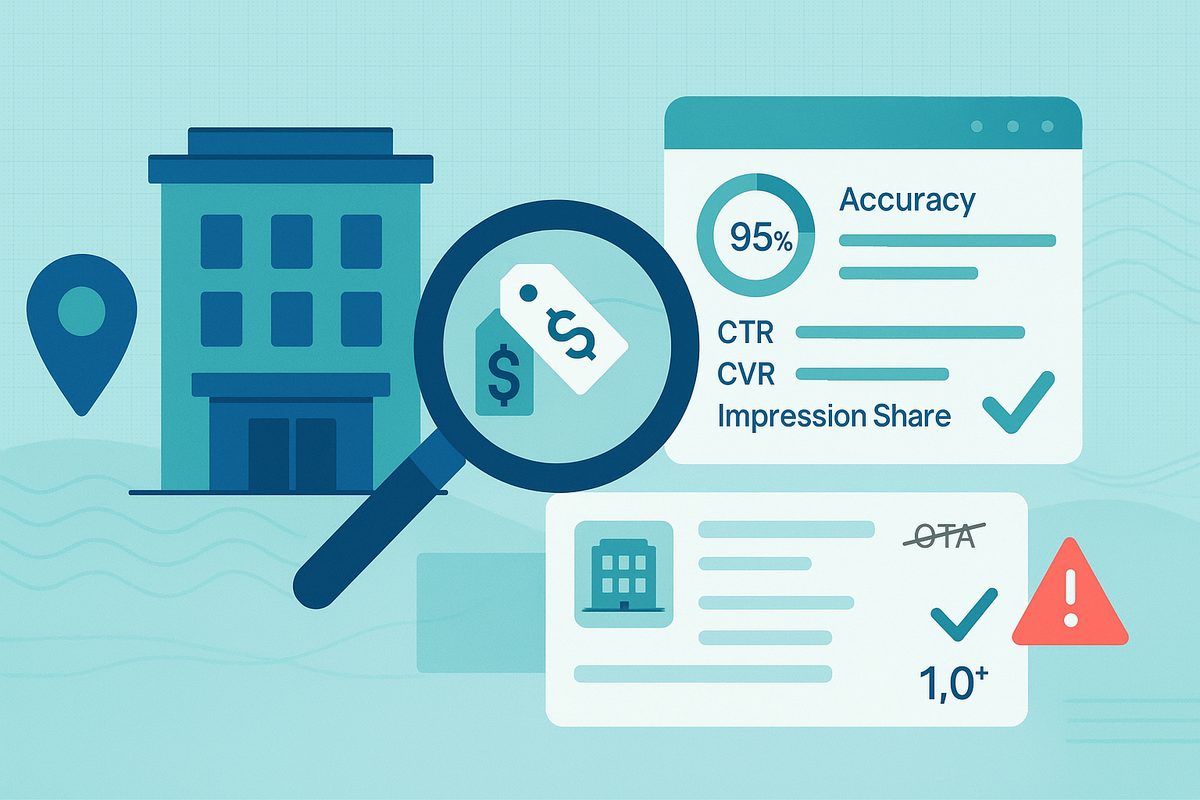
Si inviertes en Google Hotel Ads, Trivago o Tripadvisor y no estás monitoreando tu Price Accuracy, estás tirando dinero. Así de simple.
Lo digo porque lo he vivido. Pasamos semanas optimizando pujas, ajustando presupuestos, probando distintas estrategias de bidding. Y las conversiones no mejoraban. ¿El problema? El precio que mostrábamos en el metabuscador no coincidía con el precio final en el motor de reservas. El huésped llegaba, veía un número diferente y se iba. Click pagado, conversión perdida.
¿Qué es Price Accuracy y por qué deberías obsesionarte con ella?
Es la coincidencia exacta entre el precio que anuncias en el metabuscador y el precio final que ve el huésped en tu motor de reservas. Misma habitación, mismas fechas, misma ocupación, mismos impuestos.
Cuando tu Accuracy es alta (arriba del 95%), pasan cosas buenas: tu quality score sube, tus impresiones aumentan, tu CPC efectivo baja y la gente que llega a tu motor de reservas convierte más porque no se lleva sorpresas.
Cuando es baja, todo lo contrario. Google te penaliza con menos impresiones, el huésped rebota al ver un precio diferente, y terminas pagando clics que nunca iban a convertir.
Las causas más comunes de Price Accuracy baja
Impuestos y tasas que no se incluyen en el precio del feed. El huésped ve $200 en Google y al llegar al motor ve $232 con impuestos. Eso mata la conversión.
Tipo de cambio diferente entre el feed y el motor. Si vendes en dólares pero tu motor convierte a pesos con un tipo de cambio distinto al de tu feed, la discrepancia aparece.
Room mapping mal hecho. El feed envía "Deluxe Ocean View" pero el motor muestra "Suite Deluxe Vista al Mar". Google no sabe que es la misma habitación y muestra precios incorrectos.
Tarifas no vendibles en el feed. Tarifas corporativas, netas o de mayorista que se filtran al metabuscador y muestran precios que el huésped directo nunca va a poder obtener.
Lo que hago cada semana
Todos los días hago entre 5 y 10 búsquedas manuales. Busco el hotel en Google con distintas fechas, dispositivos e idiomas. Comparo lo que aparece en el metabuscador con lo que muestra el motor. Capturo pantalla de cada discrepancia.
Cada semana genero un reporte con Coverage (qué porcentaje de combinaciones tienen precio válido), Accuracy, CTR y tasa de conversión por país. Si algo baja, investigo la causa antes de tocar las pujas.
Cada mes reviso la estrategia completa: pujas brand vs non-brand, segmentación por device y mercado, calendario de picos de demanda, y paridad con OTAs.
El error más caro que cometen los hoteles
Invertir en metasearch sin monitorear paridad. Si Booking está mostrando un precio más bajo que tu canal directo en el mismo metabuscador, estás financiando la visibilidad de tu competencia. Cada clic que pagas lleva al huésped a comparar, y si la OTA es más barata, pierdes.
Implementa monitoreo de undercuts. Cuando detectes que una OTA o un afiliado está rompiendo paridad, documenta la evidencia y levanta un ticket con tu account manager. No lo dejes pasar.
Price Accuracy no es un KPI más. Es la base de todo tu metasearch. Si la base está rota, nada de lo que hagas arriba va a funcionar. Arregla eso primero y después optimiza pujas, presupuestos y segmentación.
If you invest in Google Hotel Ads, Trivago, or Tripadvisor and you're not monitoring your Price Accuracy, you're throwing money away. Plain and simple.
I say this because I've lived it. We spent weeks optimizing bids, adjusting budgets, testing different bidding strategies. And conversions weren't improving. The problem? The price we showed on the metasearch didn't match the final price on the booking engine. The guest arrived, saw a different number, and left. Paid click, lost conversion.
What is Price Accuracy and why should you obsess over it?
It's the exact match between the price you advertise on the metasearch and the final price the guest sees on your booking engine. Same room, same dates, same occupancy, same taxes.
When your Accuracy is high (above 95%), good things happen: your quality score goes up, your impressions increase, your effective CPC drops, and people who reach your booking engine convert more because there are no surprises.
When it's low, the opposite happens. Google penalizes you with fewer impressions, the guest bounces when they see a different price, and you end up paying for clicks that were never going to convert.
The most common causes of low Price Accuracy
Taxes and fees not included in the feed price. The guest sees $200 on Google and arrives at the engine to find $232 with taxes. That kills conversion.
Different exchange rates between the feed and the engine. If you sell in dollars but your engine converts to pesos with a different rate than your feed, the discrepancy appears.
Poor room mapping. The feed sends "Deluxe Ocean View" but the engine shows "Suite Deluxe Vista al Mar." Google doesn't know it's the same room and shows incorrect prices.
Non-sellable rates in the feed. Corporate, net, or wholesale rates that leak into the metasearch and show prices the direct guest can never get.
What I do every week
Every day I run between 5 and 10 manual searches. I search the hotel on Google with different dates, devices, and languages. I compare what appears on the metasearch with what the engine shows. I screenshot every discrepancy.
Every week I generate a report with Coverage (what percentage of combinations have a valid price), Accuracy, CTR, and conversion rate by country. If something drops, I investigate the cause before touching the bids.
Every month I review the complete strategy: brand vs non-brand bids, device and market segmentation, peak demand calendar, and OTA parity.
The most expensive mistake hotels make
Investing in metasearch without monitoring parity. If Booking is showing a lower price than your direct channel on the same metasearch, you're funding your competition's visibility. Every click you pay takes the guest to compare, and if the OTA is cheaper, you lose.
Implement undercut monitoring. When you detect an OTA or affiliate breaking parity, document the evidence and raise a ticket with your account manager. Don't let it slide.
Price Accuracy isn't just another KPI. It's the foundation of your entire metasearch strategy. If the foundation is broken, nothing you do on top will work. Fix that first, then optimize bids, budgets, and segmentation.
¿Quieres aplicar estas estrategias en tu hotel?
Agenda una llamada sin costo y analizamos juntos cómo aumentar tus reservas directas.